
Withholding VAT Tanzania: Agents, the 3% and 6% Rates, the 10-Day Remittance, Supplier Credits and Penalties
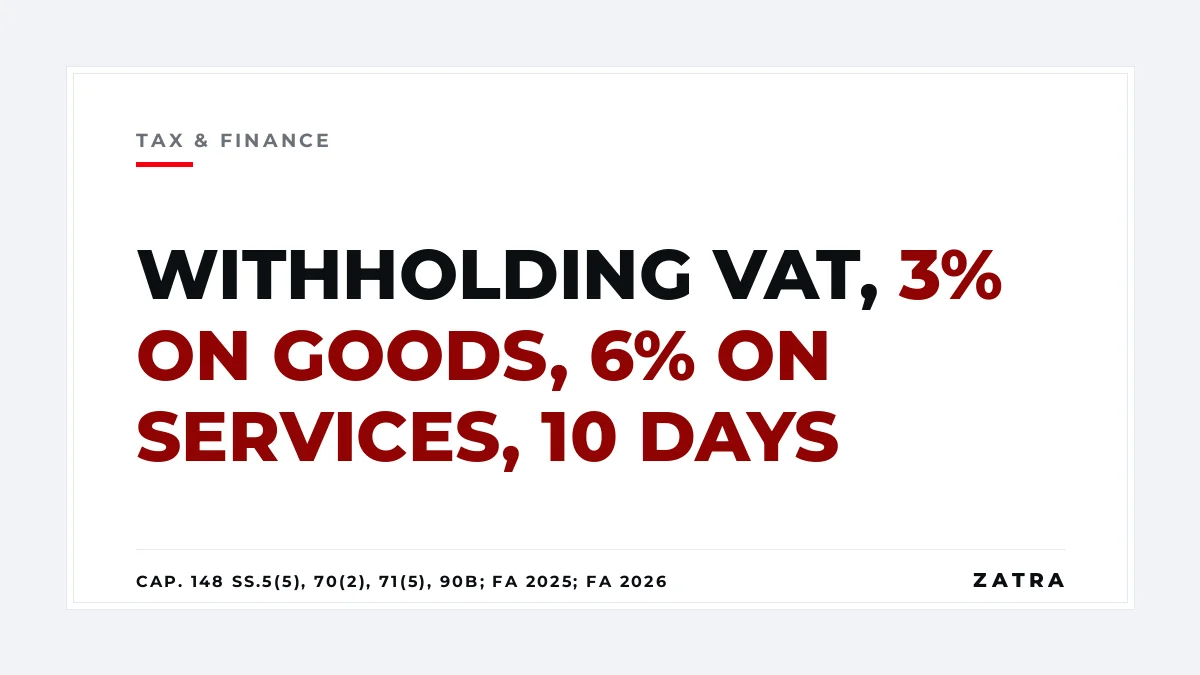
How does withholding VAT work in Tanzania? When a VAT-registered supplier makes a standard-rated supply in Mainland Tanzania to a withholding agent, VAT stays at 18%. The agent withholds 3% on goods or 6% on services, remits it to TRA within ten days after the month ends and issues a certificate. The supplier receives 15% or 12% and subtracts the withheld amount in its return.
This guide explains withholding VAT Tanzania rules under section 5(5) of the VAT Act, Cap. 148, as inserted by the Finance Act 2025 and amended by the Finance Act 2026, with a worked month for a supplier to government.
Who is affected by withholding VAT?
- Suppliers to government. VAT-registered companies that sell goods or services to the Ministry of Finance, executive agencies, regulators, local government authorities, public universities and other self-funded public bodies.
- Public bodies that pay suppliers. Accounting officers and finance teams in government entities that retain part or all of the revenue they collect.
- Registered businesses appointed as agents. Any VAT-registered person the Commissioner General appoints by notice.
- Contractors with mixed contracts. Builders, installers and IT integrators whose contracts combine equipment and labour.
- Finance teams in a refund position. Exporters and capital-heavy suppliers whose input tax already exceeds output tax.
Withholding VAT is separate from withholding income tax on service fees and goods. Our guide to withholding tax on local payments covers the income tax side, and both can apply to the same invoice.
What the law says about withholding VAT
The regime sits in the Value Added Tax Act, Cap. 148 R.E. 2023. The Finance Act, 2025, assented on 30 June 2025 and in force on 1 July 2025, inserted it. We read the operative text of that Act this session.
| Provision of Cap. 148 | What it does | Inserted or amended by |
|---|---|---|
| s.2, "withholding agent" | Defines the three classes of agent | Finance Act 2025 s.123(b) |
| s.5(5) | Rate stays 18%; agent withholds 3% on goods and 6% on services | Finance Act 2025 s.124; Finance Act 2026 s.91(a) |
| s.5(7) | Mixed supply of goods and services split 3:2 | Finance Act 2026 s.91(b) |
| s.70(2) | No subtraction of withheld output tax without a valid certificate at filing | Finance Act 2025 s.131 |
| s.71(1) | Output tax withheld by an agent is subtracted in the net amount | Finance Act 2025 s.132 |
| s.71(5) and (6) | Agent pays within ten days after the tax period and files a withholding VAT statement | Finance Act 2026 s.95 |
| s.90B | Content and timing of the withholding certificate | Finance Act 2025 s.134 |
The certificate form is in the Value Added Tax (General) (Amendment) Regulations, 2025, GN 352K, made on 29 June 2025. They add regulation 31B and a scheduled form showing 3% for goods and 6% for services.
Penalties and interest come from the Tax Administration Act, Cap. 438 R.E. 2023, not from the VAT Act. The Finance Act 2025 VAT Part added no penalty specific to withholding VAT.
What changed on 1 July 2026?
The Finance Act, 2026, assented on 30 June 2026, made three changes from 1 July 2026.
- Goods rate stated. The 2025 text set the supplier's share only for services, at 12%. Section 91(a) now states 15% for a supplier of goods and 12% for a supplier of services.
- Mixed supplies. A new section 5(7) apportions the taxable value of a supply with both goods and services in the ratio 3:2.
- Faster remittance. A new section 71(5) requires the agent to pay within ten days after the end of each tax period. A new section 71(6) adds a withholding VAT statement within the same window.
EY's alert of 17 July 2026 notes that agents previously remitted with the VAT return on the 20th. EY also flags open questions: what happens when an agent fails to withhold or remit, and whether agents must keep withholding from suppliers already in a refund position.
Who is a withholding VAT agent in Tanzania?
Section 2 of the VAT Act, as amended by the Finance Act 2025, names three classes.
- The Ministry responsible for finance.
- A government entity which retains the whole or part of its collected revenue.
- A registered person appointed by the Commissioner General by notice.
TRA's VAT page gives examples of the second class: executive agencies, regulatory authorities, self-funded public institutions and boards, local government authorities, and public universities and training institutions.
The third class depends on a published notice. We searched TRA's site and the main tax publishers and found no notice appointing private registered persons. Treat that as unknown, not as a no. A supplier should ask each large private buyer in writing whether it holds an appointment, and keep the answer on file.
A government entity funded wholly from the Treasury, which does not retain its own revenue, falls outside the second class on the statutory wording. In practice, the safer test is the buyer's own written confirmation.
How much is withheld, and what does the supplier receive?
Section 5(5) keeps the rate on a standard-rated supply to an agent at 18%. Out of that 18%, the agent withholds 3% on goods or 6% on services and pays the rest of the VAT to the supplier with the price. The fee register records the split at line F0233; the standard rate is F0239.
| Supply to an agent (Mainland) | VAT charged | Withheld by agent and paid to TRA | VAT paid to supplier | Register ID |
|---|---|---|---|---|
| Goods | 18% | 3% | 15% | F0233, F0239 |
| Services | 18% | 6% | 12% | F0233, F0239 |
| Mixed, cannot be separated | 18% | 3% on three fifths, 6% on two fifths | Balance of the 18% | F0233 |
| Zero-rated or exempt supply | 0% or none | Nothing to withhold | Not applicable | F0241 |
The percentages work on the taxable value, the price before VAT. On TZS 10,000,000 of services, VAT is TZS 1,800,000; the agent remits TZS 600,000 and pays the supplier TZS 1,200,000 of VAT. TRA's page words it as "3% of the consideration", and section 5(7) speaks of "the taxable value which is subject to withholding". We read both as the VAT-exclusive value; confirm with TRA before a contract is priced on a VAT-inclusive basis.
Withholding VAT is not an extra tax. The supplier still accounts for the full 18% as output tax and gets credit for the part the agent paid.
How is a mixed supply of goods and services split?
Many public contracts bundle supply and installation, or hardware and support. Before 1 July 2026 the law gave no rule, so agents chose their own split. Section 5(7) now apportions the taxable value 3:2 where a supply has both elements of goods and services.
On a TZS 20,000,000 contract that cannot be separated, TZS 12,000,000 is treated as goods and TZS 8,000,000 as services. The agent withholds TZS 360,000 plus TZS 480,000, so TZS 840,000 in total.
The ratio is a fallback, not a pricing rule. Where a contract prices goods and services separately, the separate figures should drive the withholding. Write the split into the contract and the invoice, so the agent's certificate matches the supplier's books.
How does the supplier claim credit for VAT withheld?
The supplier reports its full output tax in the monthly return and subtracts the output tax withheld under section 71(1). Section 70(2) allows that subtraction only where the supplier holds a valid withholding certificate when it files. Section 90B(2) adds that a certificate missing the required details cannot be used.
- Match each certificate to an invoice. Agree the agent's name, TIN and VRN, the supply, the consideration, the VAT and the amount withheld.
- Claim in the right month. A certificate that arrives after the 20th cannot support that month's return. The certificate deadline in section 90B(1) is designed to prevent this.
- Do not pay the withheld part twice. Without the certificate, the supplier pays the full 18% itself and then chases the agent. That is the main cash risk of the regime.
The return is due by the 20th of the following month (register F0245). Our guide to the monthly VAT return walks through the IDRAS screens and the full return.
What must the invoice, EFD receipt and certificate show?
The supplier's fiscal document does not change. The rate stays at 18%, so the tax invoice and the EFD or VFD receipt show the full VAT at 18%. The withheld amount appears on the agent's certificate, not as a lower rate on the receipt. We have not seen TRA guidance on EFD configuration for agent sales, so confirm it with TRA if a device prompts for a 15% or 12% rate.
Section 90B(1) requires the agent to issue the certificate no later than the day VAT becomes payable on the supply under section 15. It is generated by a system the Commissioner General approves. TRA's VAT page says the certificate is generated through IDRAS. It must show:
- the date of issue;
- the agent's name, TIN and VRN;
- a description, quantity and other specifications of the supply;
- the total consideration and the VAT included in it;
- the rate and amount of VAT withheld; and
- the supplier's name, address, TIN and VRN.
An EFD receipt is still required for each sale. Failing to issue one is an offence under section 97 of the Tax Administration Act, with a fine of 20% of the value or 100 currency points, capped at 200 currency points (register NEW-02-13). See our guide to what an EFD receipt must show.
When must the agent remit and file?
From 1 July 2026, section 71(5) requires the agent to pay the VAT withheld to the Commissioner within ten days after the end of each tax period. The tax period is the calendar month. Section 71(6) requires a withholding VAT statement within ten days of the month following the tax period.
TRA's VAT page puts it as filing and paying on or before the 10th day of the following month. We use the 10th as the working deadline. Payment goes through a GePG control number generated in IDRAS, as with other domestic taxes.
Before 1 July 2026, the agent remitted when the VAT return was due, on the 20th, or as the Commissioner General directed. A government agent that is also VAT-registered therefore now has two monthly dates: the 10th for withholding and the 20th for its own return.
How does withholding VAT interact with the 16% reduced rate?
Section 5(6), inserted by the same 2025 section, sets 16% on a standard-rated supply to an unregistered person in Mainland Tanzania who pays by bank or an approved electronic system (register F0240). Its statutory start date was 1 September 2025.
It is not applied yet. A TRA public notice of 2 September 2025 says the reduced rate depends on a further notice naming eligible persons and the manner of implementation. PwC's summary, last reviewed 9 September 2026, still describes it as pending. Until the notice appears, charge 18%.
| Feature | Withholding VAT, s.5(5) | Reduced rate, s.5(6) |
|---|---|---|
| Buyer | A withholding agent | An unregistered person paying by bank or approved e-payment |
| Rate on the supply | 18% | 16% |
| Who pays TRA | Agent 3% or 6%; supplier the balance through its return | Supplier, through its return |
| Proof needed | Withholding certificate, s.70(2) | Proof of bank or electronic payment, s.70(3) |
| Status at 28 October 2026 | In operation | Awaiting TRA notice |
| Register ID | F0233 | F0240 |
The two rules target different buyers. A self-funded public body that is not VAT-registered could, on the wording, fall under both. Nothing published resolves that overlap, so it is an item to confirm once the 16% notice issues.
What penalties apply to agents and suppliers?
The fixed penalties are measured in currency points. One currency point is TZS 20,000 (register NEW-02-05), as TRA's interest and penalties page confirms.
| Failure | Charge | Register ID | TAA section |
|---|---|---|---|
| Late return or late payment | Higher of 2.5% of tax assessable less tax paid, or 15 currency points (TZS 300,000) for a body corporate, per month or part month | NEW-02-06 | s.89 |
| Tax paid late | Interest at the statutory rate, compounded monthly | NEW-02-08 | s.87 |
| False or misleading statement | 50% of the shortfall, or 75% if knowing or reckless | NEW-02-11 | s.90 |
| No fiscal receipt issued | 20% of the value or 100 currency points, capped at 200 currency points | NEW-02-13 | s.97 |
For a supplier, the exposure is ordinary: a late or short VAT return. Subtracting withheld VAT without a valid certificate creates a shortfall, with interest and possibly the false statement penalty.
For an agent, the law is less clear. The withholding VAT statement is a return under section 71(6), so the late filing penalty in section 89 should reach it, and section 87 interest should run on late payment. Neither the VAT Act nor the Tax Administration Act states expressly that an agent who fails to withhold becomes liable for the VAT. EY flagged this gap. Treat agent liability as a point to confirm, and keep remitting on time.
Remission of penalties and interest can be sought under section 81. Our guide to TRA penalties and interest covers how to ask.
What if the supplier ends up in a refund position?
A supplier whose input tax already exceeds output tax gains nothing from paying less output tax. Withholding moves cash from the supplier to TRA earlier, and the supplier recovers it as a credit. For an exporter, a builder buying heavy equipment or a start-up, that credit can turn into a refund claim.
Under Cap. 148, a negative net amount is carried forward under section 85, and a refund is claimed under sections 86 and 88. The fee register records TRA's published timelines: a decision within 90 days of a correct application and payment within 14 days of the decision (NEW-02-23). Our VAT refund guide explains the application and the audit that usually follows.
The law has no exemption from withholding for suppliers in a refund position. Price long contracts with the cash delay in mind.
Does withholding VAT apply in Zanzibar?
No, not this regime. Section 5(5) applies to a supply "made in Mainland Tanzania" to a withholding agent. VAT in Zanzibar is a non-Union tax under a separate Act, administered by the Zanzibar Revenue Authority (ZRA).
The ZRA VAT page cites the Value Added Tax Act No. 4 of 1998 and a 15% standard rate, with 18% on banking, insurance, telecommunications and certain digital services. The register records 15% and a TZS 100 million threshold (F0246). The ZRA page does not mention withholding VAT, and we found no Zanzibar equivalent.
| Item | Mainland Tanzania | Zanzibar |
|---|---|---|
| Law | VAT Act, Cap. 148 | VAT Act No. 4 of 1998 (Zanzibar) |
| Administrator | TRA | ZRA |
| Standard rate | 18% (F0239) | 15%; 18% on some services (F0246) |
| Withholding VAT by agents | 3% goods, 6% services (F0233) | No equivalent found; confirm with ZRA |
| Agent remittance | Within ten days after the month | Not applicable on current information |
A company selling to a Zanzibar public body from the Mainland should get ZRA's written position on where the supply is taxed. Our comparison of Zanzibar and Mainland VAT sets out the two systems.
Worked example: one month for a supplier to government in Dar es Salaam
Mwambao Systems Ltd is a hypothetical VAT-registered IT company in Dar es Salaam. In October 2026 it makes four sales. All amounts are in TZS, before VAT unless stated, and illustrative.
| Sale in October 2026 | Taxable value | Output VAT at 18% | Withheld by agent | VAT received from buyer |
|---|---|---|---|---|
| Consulting services to a self-funded regulator | 40,000,000 | 7,200,000 | 2,400,000 (6%) | 4,800,000 (12%) |
| Laptops to a Ministry | 25,000,000 | 4,500,000 | 750,000 (3%) | 3,750,000 (15%) |
| Network installed for a council, one price | 10,000,000 | 1,800,000 | 420,000 (3:2 split) | 1,380,000 |
| Sales to private companies | 30,000,000 | 5,400,000 | Nil | 5,400,000 |
| Total | 105,000,000 | 18,900,000 | 3,570,000 | 15,330,000 |
For the council job, the 3:2 split treats TZS 6,000,000 as goods and TZS 4,000,000 as services. Withholding is TZS 180,000 plus TZS 240,000, so TZS 420,000.
Input tax on October purchases, backed by tax invoices and EFD receipts, is TZS 9,000,000. The October return, due by 20 November 2026, works as follows:
- Output tax: TZS 18,900,000.
- Less input tax: TZS 9,000,000.
- Less output tax withheld, with three valid certificates: TZS 3,570,000.
- Net VAT payable: TZS 6,330,000.
The check works: VAT collected in cash (TZS 15,330,000) less input tax (TZS 9,000,000) equals the TZS 6,330,000 payable.
Now assume the regulator has not issued its certificate by 20 November. Section 70(2) blocks the TZS 2,400,000 subtraction, so Mwambao pays TZS 8,730,000 and chases the certificate. The regulator, for its part, had to remit the TZS 2,400,000 by 10 November.
If the regulator remits a month late, the penalty is the higher of 2.5% of TZS 2,400,000 (TZS 60,000) or TZS 300,000 for a body corporate (NEW-02-06). Interest at 8.75% a year (NEW-02-09) adds about TZS 17,500. One month's delay costs about TZS 317,500, if section 89 applies to the statement as we expect.
Income tax withholding sits on top. The regulator also withholds 5% income tax on the consulting fee (F0212), and the Ministry withholds 2% on goods supplied to government (F0223). Those amounts are credits against income tax, not VAT.
What to do now
- List your agent customers. Mark every public body that retains its own revenue and every private buyer that confirms an appointment.
- Fix the contract wording. Price before VAT, state VAT at 18%, and separate goods from services so the 3:2 fallback is not needed.
- Invoice at 18%. Issue the EFD or VFD receipt and tax invoice with the full VAT, and quote the invoice number in the payment request.
- Collect certificates before the 20th. Match each one to an invoice, and reject any that lacks the section 90B details.
- Reconcile cash monthly. Compare VAT received with VAT invoiced, and chase every gap that has no certificate behind it.
- Agents: remit by the 10th. Pay against a GePG control number and file the withholding VAT statement in IDRAS within ten days after the month.
- Plan for refunds. Where withholding pushes a supplier into credit, prepare the refund file early and budget for the wait.
- Check Zanzibar separately. For island buyers, ask ZRA in writing which law and rate apply.
Key dates and deadlines
| Date or period | What happens | Source |
|---|---|---|
| 30 June 2025 | Finance Act 2025 assented; GN 352K published with the certificate form | Finance Act 2025; GN 352K |
| 1 July 2025 | Withholding VAT provisions and GN 352K in force | Finance Act 2025 s.2 |
| 1 September 2025 | Statutory start of the 16% rate; EY reported withholding as operational from this date | Finance Act 2025 s.124; EY |
| 2 September 2025 | TRA notice: 16% awaits a further notice | TRA public notice |
| 1 July 2026 | Finance Act 2026: 15% goods share, 3:2 split, ten-day remittance and statement | Finance Act 2026 ss.91, 95 |
| By the 10th of each month | Agent remits withheld VAT and files the statement for the previous month | s.71(5), (6); TRA VAT page |
| By the 20th of each month | Supplier files its VAT return and pays the net amount | s.70(1); F0245 |
| Six months from the invoice | Last point to claim input tax | F0245 |
| 30 days from a decision | Objection to an assessment, with the admission deposit | TAA s.62; NEW-02-19 |
How Zatra helps
Our tax compliance desk files monthly VAT returns, tracks certificates and reconciles withheld VAT for suppliers to government. Our bookkeeping team sets up the ledger accounts that keep the withheld VAT visible. Where TRA audits or assesses, our audit and dispute desk prepares the response. Bidders can read our guide to registering as a government supplier.
Costs come in two separate buckets. VAT, penalties and interest are paid to TRA at the official amount against a GePG control number. Zatra's professional fee is quoted on its own line and never mixed with them.
Zatra prepares and coordinates, but does not decide or guarantee any authority's outcome. Objections that go to the Tax Revenue Appeals Board or Tribunal, prosecution, search and seizure, and formal legal opinions go to an advocate. See appealing a TRA assessment.
Sources and status
Accurate as at 28 October 2026.
- Finance Act, 2025: TRA copy; assented 30 Jun 2025; ss.123, 124, 131, 132 and 134 read. Accessed 28 Oct 2026.
- Finance Act, 2026: TRA copy; assented 30 Jun 2026; ss.91 and 95 read. Accessed 28 Oct 2026.
- Value Added Tax Act, Cap. 148 R.E. 2023: TRA copy, cited at section level. Accessed 28 Oct 2026.
- VAT (General) (Amendment) Regulations, 2025, GN 352K: TRA copy, 30 Jun 2025. Accessed 28 Oct 2026.
- Value Added Tax: TRA, page live October 2026. Accessed 28 Oct 2026.
- Effective application of the 16% rate: TRA public notice, 2 Sep 2025. Accessed 28 Oct 2026.
- Interest, penalties and offences: TRA, page live October 2026. Accessed 28 Oct 2026.
- Value Added Tax: Zanzibar Revenue Authority, page live October 2026. Accessed 28 Oct 2026.
- EY on the Finance Act 2025: 4 Aug 2025; and EY on the Finance Act 2026: 17 Jul 2026. Accessed 28 Oct 2026.
- PwC, Tanzania other taxes: last reviewed 9 Sep 2026. Accessed 28 Oct 2026.
- Clyde & Co on the Finance Act 2025: 3 Jul 2025; and Auditax International: 10 Jul 2025. Accessed 28 Oct 2026.
- Zatra fee register, fees at 26 Sep 2026; line IDs as cited in the text. Accessed 28 Oct 2026.
Figures to confirm before you act
- Base: that 3% and 6% apply to the VAT-exclusive taxable value, not the VAT-inclusive consideration
- Appointed agents: whether the Commissioner General has published any notice appointing private registered persons
- Start date: the date TRA began operating withholding in practice; the Act ran from 1 July 2025 and EY reported 1 September 2025
- Agent liability: whether an agent that fails to withhold becomes liable for the VAT, and which penalty applies to a late statement
- EFD set-up: any TRA instruction on how fiscal devices record a sale to an agent
- 16% rate: the TRA notice naming eligible persons, and how it treats unregistered public bodies
- Agent input tax: how a VAT-registered agent claims input tax on a supply where it withheld part of the VAT
- Statutory rate: the rate for the quarter you pay; 8.75% applied in the third quarter of 2026 (NEW-02-09)
- Zanzibar: ZRA's written position on any withholding mechanism and on cross-border supplies to island public bodies
This article is general information based on official sources available at the date of publication. It is not legal, tax or financial advice. Laws and notices change. Verify with the issuing authority or consult Zatra before acting.
Frequently asked questions
Does a supplier that is not VAT-registered suffer withholding VAT?
No. Withholding applies to a standard-rated supply on which VAT is charged, and only a registered person charges VAT. An unregistered supplier invoices without VAT, so the agent has nothing to withhold. Income tax withholding on the payment can still apply.
Can a government buyer pay the supplier only the price and send all the VAT to TRA?
Not under section 5(5). The agent withholds 3% or 6% and pays the balance of the VAT to the supplier. Paying less leaves the supplier short with no certificate to cover the gap. Raise it in writing with the accounting officer and keep the correspondence.
What happens if the certificate shows the wrong amount?
Section 90B(2) bars the use of a certificate that does not meet the statutory content rules. Ask the agent to cancel and reissue it through IDRAS before the 20th. Claim only the amount the corrected certificate supports.
Does withholding VAT apply to imports by a government entity?
No. Section 5(5) covers a supply made in Mainland Tanzania to an agent. VAT on imports is collected at customs under section 8 of the VAT Act, and no withholding certificate arises at the border.
Is a withheld amount lost if the supplier misses the six-month input tax window?
The six-month rule in register line F0245 is about input tax, not withheld output tax. Even so, the claim needs a valid certificate at filing. Claim in the month of supply where possible, and ask TRA in writing about a late certificate.
Do the 3% and 6% rates change for a supply at 16%?
The question does not arise yet. The 16% rate awaits a TRA notice, and section 5(5) applies only where the supply is taxable at the standard rate. Until TRA says otherwise, a supply to an agent carries 18% and the normal withholding split.
Can an appointed private agent withhold from a supplier in Zanzibar?
Not under the Mainland Act. Section 5(5) is limited to supplies made in Mainland Tanzania. Supplies made in Zanzibar fall under Zanzibar VAT law and ZRA, which has published no withholding regime that we could find.
How should withheld VAT appear in the supplier's books?
Record the full 18% as output VAT, and the withheld amount as a receivable from TRA backed by the certificate. Clear the receivable when the return subtracts it. A separate ledger account per agent makes missing certificates visible each month.
Sources & regulators
Verify before filing: Rates, forms and thresholds move by Finance Act, Government Notice and portal revision. Confirm the live schedule on the mandate-holder portal before you budget or submit. Law-firm alerts and Big Four notes are discovery only.
- Finance Act, 2025: Tanzania Revenue Authority copy; assented 30 Jun 2025, in force 1 Jul 2025; ss.123(b), 124, 131, 132 and 134 insert the withholding agent definition, s.5(5), s.5(6), s.70(2), s.71(1) and (5), s.90B; primary source. Accessed 2026-10-28.
- Finance Act, 2026: Tanzania Revenue Authority copy; assented 30 Jun 2026, in force 1 Jul 2026; s.91 (15% goods share, 3:2 ratio) and s.95 (ten-day remittance, withholding VAT statement); primary source. Accessed 2026-10-28.
- Value Added Tax Act, Cap. 148 R.E. 2023: Tanzania Revenue Authority copy, Revised Edition 2023; cited at section level; primary source. Accessed 2026-10-28.
- Value Added Tax (General) (Amendment) Regulations, 2025, GN 352K: Government Notice 352K, made 29 Jun 2025, published 30 Jun 2025; regulation 31B and the withholding certificate form (3% goods, 6% services); primary source. Accessed 2026-10-28.
- TRA: Value Added Tax (VAT): Tanzania Revenue Authority, page live October 2026; agent classes, 3% and 6%, supplier receives 15% or 12%, certificate through IDRAS, remit by the 10th; primary source. Accessed 2026-10-28.
- TRA: Effective application of VAT reduced rate of 16%: Tanzania Revenue Authority public notice, 2 Sep 2025; reduced rate awaits a further notice; primary source. Accessed 2026-10-28.
- TRA: Interest, penalties and offences: Tanzania Revenue Authority, page live October 2026; 2.5% or 5/15 currency points; currency point TZS 20,000; primary source. Accessed 2026-10-28.
- ZRA: Value Added Tax: Zanzibar Revenue Authority, page live October 2026; VAT Act No. 4 of 1998, 15% standard rate, 18% on specified services; official source. Accessed 2026-10-28.
- EY: Tanzanian Finance Act, 2025 analysis: EY Global Tax Alert, 4 Aug 2025; withholding agents, 3% and 6%, operational 1 Sep 2025; independent source. Accessed 2026-10-28.
- EY: Tanzanian Finance Act, 2026 analysis: EY Global Tax Alert, 17 Jul 2026; ten-day remittance, 3:2 ratio, open questions on agent failure and refund positions; independent source. Accessed 2026-10-28.
- PwC Worldwide Tax Summaries: Tanzania corporate other taxes: PwC, last reviewed 9 Sep 2026; withholding VAT from 1 Jul 2025, 16% rate pending notice, Zanzibar rates; independent source. Accessed 2026-10-28.
- Clyde & Co: Tanzania tax update, Finance Act 2025 highlights: Clyde & Co, 3 Jul 2025; agent classes, certificate requirement, remittance with the return; independent source. Accessed 2026-10-28.
- Auditax International: Finance Act 2025 and financial institutions: Auditax International, 10 Jul 2025; agent classes and certificate timing; independent source. Accessed 2026-10-28.
Disclaimer
This article is informational orientation. It is not legal, tax or investment advice and not a government decision. Tanzanian instruments move by Act, Government Notice, Finance Act and portal revision. If a sentence here disagrees with the live mandate-holder, the mandate-holder wins. Zatra Consultants Limited does not issue licences, permits, tax clearances or approvals, and gives no assurance of any regulatory or banking outcome. Professional fees are published only on /pricing/.